

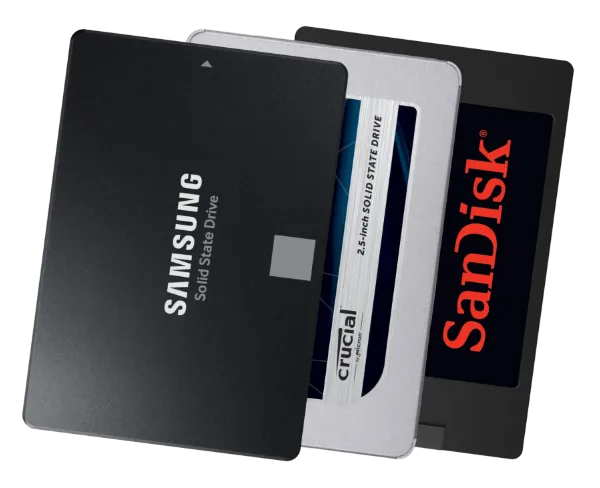
While NVMe drives dominate headlines and new builds (as they should), SATA SSDs still hold considerable value for specific use cases. Whether you're upgrading an older system without M.2 slots, populating a NAS, or simply need cost-effective secondary storage, SATA drives are still far superior to mechanical hard drives.
However, several major manufacturers have discontinued high-end SATA models, and Crucial has exited the consumer market entirely as parent company Micron diverts production to data center products. What's left of the premium SATA SSD space is mainly mature, proven designs rather than new innovations.
Some of the best-performing 2.5" SATA solid state drives still available in 2026 include:
- Samsung 870 EVO
- OWC Mercury Extreme Pro 6G
- WD Red SA500
Most entry-level SATA SSDs today use DRAM-less controllers and often QLC NAND to hit aggressive price points. Only select, higher-end models come with DRAM caching and more durable TLC NAND. Keep reading for a comprehensive overview of the current options.
The Fastest SATA SSDs in 2025
As focus has shifted to high-end M.2 PCIe SSDs, the high-end SATA market has essentially stagnated. Many flagship SATA models from previous years have been discontinued. As a result, the fastest SATA drives available in 2026 are largely carryovers from 2020-2021. If you prioritize performance and endurance, your best options are:
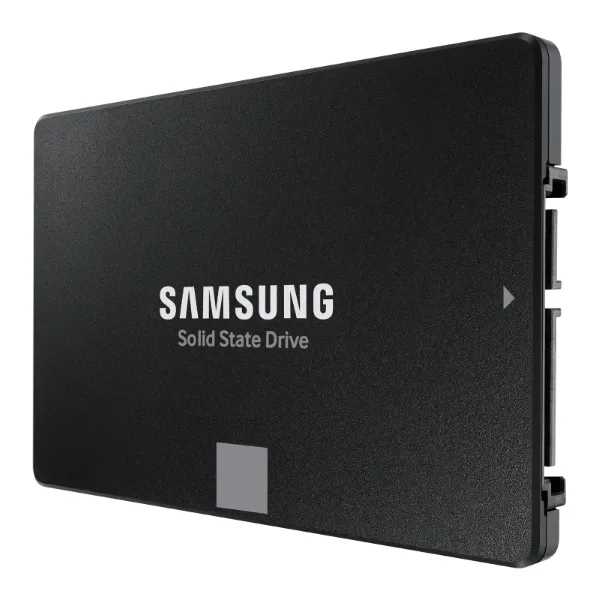
The Samsung 870 EVO is still a clear leader in the consumer SATA space, although it launched in 2021. It's Samsung's final high-end SATA offering and goes out on a high note with excellent performance with proven reliability. To be fair, it has in part maintained the lead due to a lack of competition.
There are exceptions though. If you are looking for a rare combo of both solid performance and high endurance, the OWC Mercury Extreme Pro 6G uses the Phison S12 controller and offers 7% NAND over-provisioning. This is the same controller that powered the now-discontinued Seagate FireCuda 120, delivering exceptional sustained performance and reliability.
List of High-End 2.5-Inch SATA SSDs
Moving on to a more complete list of SSDs, these rankings are based on an average of read/write performance. Random performance is weighted the highest as it's typically associated with the best real-world performance. For a more complete story, head over to the reviews linked in the descriptions.
 1. Samsung 870 EVO
Available Capacities: 250GB - 4TB Interface: SATA 6 Gbps 560 MB/s read (1TB) 530 MB/s write (1TB) Endurance Rating (1TB): 600 TBW
Samsung's 870 EVO remains the flagship SATA SSD in 2026. It's a continuation of Samsung's long-running and highly successful EVO series. While the SATA interface bandwidth ceiling prevents major performance gains, Samsung's refined MKX controller and 128-layer 3D TLC NAND deliver slight improvements over its predecessors.
A combination of strong sequential speeds, excellent random performance, and Samsung's proven track record makes this the default recommendation for most users looking for a reliable SATA SSD in 2026. Along with the Phison S12-based options, the 870 EVO is likely one of the last high-end SATA releases from big-name brands we'll ever see in the consumer market.
Check prices: Amazon, Newegg, Amazon UK
Reviews: LegitReviews
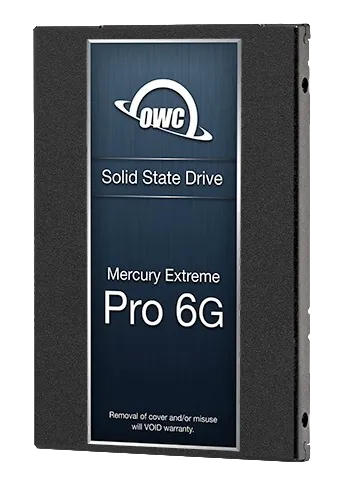 2. OWC Mercury Extreme Pro 6G (Phison S12 Version)
Available Capacities: 240GB - 4TB Interface: SATA 6 Gbps Max. Sequential Performance: 559 MB/s read, 527 MB/s write Max. Random Performance: 100K IOPS read, 90K IOPS write Endurance Rating (2TB): 1,500 TBW
This is not the first SSD that OWC sells under the name Mercury Extreme Pro 6G. An earlier revision used the ancient SandForce SF-2200 controller, but it is now equipped with TLC NAND from Micron and the same Phison S12 controller as the Seagate FireCuda (and IronWolf) 120.
In other words, it is one of the fastest 2.5" SSDs in the (admittedly very small) high-end SATA space. Although it doesn't match Seagate's rather extreme endurance rating, the Mercury Extreme Pro 6G comes with 7% NAND over-provisioning, resulting in above-average endurance.
There isn't an abundance of reviews of this drive (or SATA drives in general), but TweakTown has tested it and reviews of the FireCuda 120 (such as this one) should also be indicative.
Check price (2TB): Amazon
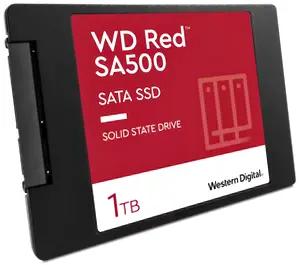 3. WD Red SA500 NAS SSD
Available Capacities: 500GB - 4TB Interface: SATA 6Gbps 560 MB/s read 530 MB/s write Endurance Rating (1TB): 600 TBW
The WD Red SA500 is essentially a specialized version of the WD Blue/SanDisk Ultra 3D. All three use the same Marvell 88SS1074 controller and 64-layer TLC NAND. However, the Red SA500 targets NAS users with improved endurance ratings and overprovisioning.
Sequential throughput matches other high-end SATA drives at 560 MB/s read and 530 MB/s write, while the higher endurance rating makes it particularly suitable for network storage applications. Of course, nothing prevents you from using it in a desktop build if the price is right. The SA500 remains a solid choice for 24/7 operation.
Reviews: TechPowerup
 4. Samsung 860 EVO
Available Capacities: 250GB – 4TB 550 MB/s read 520 MB/s write Endurance Rating (1TB): 600 TBW
The 860 EVO, successor to Samsung's incredibly successful 850 EVO, is still available in limited quantities. It's a great alternative to the newer 870 EVO if you are lucky enough to find it at a substantial discount.
Performance is essentially identical in real-world use. It also offers excellent endurance numbers and comes with a 5-year warranty. However, given that the 870 EVO is often similarly priced with slightly better specifications, most will opt for the newer model unless the 860 EVO is significantly cheaper.
Reviews: TweakTown
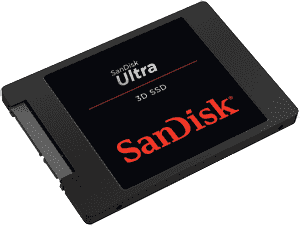 5. SanDisk Ultra 3D (or WD Blue)
Available Capacities: 250GB - 4TB Interface: SATA 6Gbps 560 MB/s read 530 MB/s write Endurance Rating (1TB): 400 TBW
The Ultra 3D from SanDisk (a Western Digital subsidiary) delivers excellent performance at reasonable prices. Sequential speeds reach 560 MB/s read and 530 MB/s write, complemented by strong random performance at 95K/84K IOPS. The drive uses a Marvell 88SS1074 controller paired with 64-layer TLC NAND.
This makes it functionally identical to the WD Blue SSD in everything but name. Both drives offer good value and proven reliability, though they typically cost more than the budget alternatives discussed below.
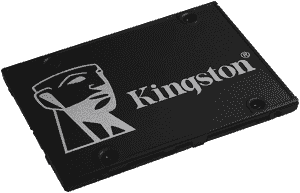 6. Kingston KC600
Available Capacities: 256GB - 2TB Interface: SATA 6Gbps 550 MB/s read 520 MB/s write Endurance Rating (1TB): 600 TBW
Kingston's KC600 was launched in 2019 and comes with a Silicon Motion SM2259 controller and 96-layer 3D TLC NAND from Micron. Although it is a bit more expensive than many of its competitors, it does offer hardware-based 256-bit AES encryption, making it an interesting option for business users. The overall specs are also excellent.
Performance-wise, it's slightly slower than the Samsung 860 series but still in the high-end SATA territory. Random performance is up to 90,000/80,000 IOPS (read/write). Another plus is that the endurance ratings are on par with the best.
Check prices: Amazon, Newegg, Amazon UK
Reviews: Hexus.net
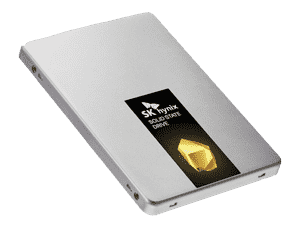 7. SK Hynix Gold S31
Available Capacities: 250GB - 1TB Interface: SATA 6GBps 560 MB/s read 525 MB/s write Endurance Rating (1TB): 600 TBW
South Korean manufacturer SK Hynix is primarily known for DRAM production, but the company also produces NAND flash. The Gold S31 is one of SK Hynix's first consumer-branded SSDs and immediately established itself among segment leaders.
Like most high-end SATA SSDs, it saturates the SATA III interface. In real-world tests, it competes with (and sometimes surpasses) drives like the Samsung 860 EVO and Crucial MX500. Availability is somewhat limited compared to Samsung drives, but it's worth considering when in stock.
Check prices: Amazon, Amazon UK
Reviews: TweakTown, AnandTech (archived)
2.5" SSDs with the Best Endurance Ratings
The 6 Gbps bandwidth limit is one reason high-end SATA SSDs have become scarce in 2026. Sequential performance gains are no longer possible. However, endurance ratings remain critically important for long-term, high-intensity workloads. This is how some of the leaders stack up:
| Endurance Rating by Capacity |
1 TB | 2 TB | 4 TB |
|---|---|---|---|
| 1. Samsung 860 PRO (discontinued) | 1,200 TBW | 2,400 TBW | 4,800 TBW |
| 2. OWC Mercury Extreme Pro 6G | 750 TBW | 1,500 TBW | N/A |
| 3. WD Red SA500 | 600 TBW | 1,300 TBW | 2,500 TBW |
| 4. Samsung 870 EVO | 600 TBW | 1,200 TBW | 2,400 TBW |
| 5. Kingston KC600 | 600 TBW | 1,200 TBW | N/A |
| 6. SK Hynix Gold S31 | 600 TBW | N/A | N/A |
| 7. SanDisk Ultra 3D | 400 TBW | 500 TBW | 600 TBW |
| 8. Crucial MX500 (discontinued) | 360 TBW | 700 TBW | 1,000 TBW |
The MLC-based Samsung 860 PRO was well ahead of the competition in endurance, though it's now discontinued and only available at inflated prices through third-party sellers. Among currently available drives, the OWC Mercury Extreme Pro 6G and WD Red SA500 lead the pack thanks to over-provisioning and optimized firmware.
The 2026 SATA Market in a Nutshell
The SATA SSD space is slowly but certainly fading. Some developments that have reshaped the market:
Major Discontinuations
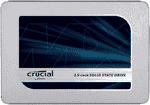 Crucial discontinued its legendary MX500 in December 2024, removing one of the most popular SATA SSDs from the market. The MX500 topped sales charts for nearly seven years with its combination of TLC NAND, DRAM caching, attractive pricing, and a five-year warranty. Some stock may still be available but no new units are being produced.
More recently, Micron announced in December 2025 that it's shutting down the entire Crucial consumer brand. All of its NAND flash and DRAM production capacity are now destined for AI data centers, where the margins are far higher.
Samsung's high-end 860 PRO is also discontinued. This MLC-based drive offered exceptional endurance ratings but commanded premium pricing.
Why SATA SSDs Still Matter
Although budget NVMe drives are now a better choice for most modern PC builds, SATA SSDs remain relevant for:
- Legacy system upgrades: Millions of PCs and laptops from the 2010s lack M.2 slots but still have SATA ports. For these systems, a SATA SSD is obviously much better than any mechanical drive.
- NAS and server applications: Many network attached storage devices come with 2.5" SATA drive bays. The WD Red SA500 specifically targets this market.
- Secondary storage: Even modern motherboards often include four or more SATA ports, and in some cases just one or two M.2 slots. SATA SSDs can serve as cost-effective secondary storage alongside a primary NVMe boot drive.
- Budget builds: SATA SSDs sometimes offer better value per gigabyte than entry-level NVMe drives, though this advantage has narrowed considerably.
The Budget Alternative Landscape
For users prioritizing cost over peak performance, there are plenty of entry-level, DRAM-less options available. These drives often use QLC NAND, resulting in lower sustained write performance and much lower endurance. Examples include:
- Crucial BX500: While the premium MX500 is discontinued, the budget BX500 remains available with limited stock. It uses TLC NAND and typically costs just $70-80 for 1TB.
- Kingston A400: One of the longest-running budget SATA SSDs, offering capacities up to 960GB at aggressive pricing.
- WD Blue SA510: Western Digital's budget offering, which replaced the DRAM-equipped WD Blue 3D NAND with a DRAM-less design.
These drives are perfectly fine for everyday use like web browsing, office work, and game storage.
Understanding SSD Specs
Anyone new to all the acronyms used on product pages and SSD discussions will find them largely incomprehensible. Here are some of the most common.
What Does SLC, MLC, TLC, and QLC Mean?
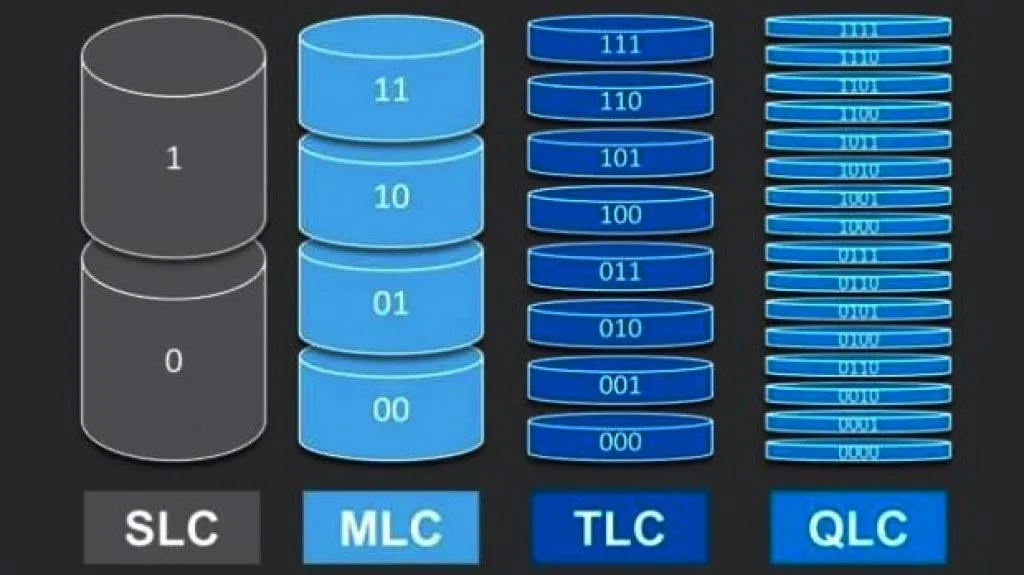 An SSD's performance, as well as its life span, is to a large extent determined by the quality of the memory cells. Higher-quality memory (NAND) not only performs better but can also be erased and written to a larger number of times before it wears out.
SLC (single-level cell) NAND Flash memory is more durable than MLC (multi-level cell, two bits per cell), which in turn is more durable than TLC (triple-level cell) NAND.
More recently, QLC (quad-level cell) drives such as the Samsung QVO have also become common. Additional bits per cell affect performance negatively because it makes the cells considerably more error-prone. There are clever technologies that compensate for this, but in the end, there is no substitute for higher-quality NAND.
Needless to say, high-end memory chips are more expensive to make. There are no SSDs based on SLC memory in the market today (it has always been prohibitively expensive), and very few outside of the enterprise market use MLC. Samsung's PRO lineup is an exception, excluding the 980 and 990 PRO, which are TLC-based.
SSD endurance: What is MTBF and TBW?
MTBF is short for mean time before failure and is more relevant for conventional hard drives than SSDs, which have no mechanical parts prone to failure over time. TBW (terabytes written or total bytes written) is much more useful. This number indicates how much data can be written to the drive before it wears out. It is determined by the drive's capacity, spare capacity (also known as overprovisioning), and the quality of the NAND memory chips.
For a drive with a 600 TBW rating, 600 TB is the amount of data the manufacturer guarantees can be written to it. Warranties are however mutually exclusive with a set number of years (usually five). This is not to say that an SSD will necessarily fail after this amount of data has been written.
Production Processes
Unlike other PC parts such as a CPU or GPU, a smaller production process as measured in nanometers (nm), is not a strong selling point, as this results in lower durability, all else being equal. For the average gamer or office user, durability is rarely an issue since most SSDs likely outlive the rest of the computer by a fair margin. Low-cost drives with cheap NAND should, however, not be used in a server or other environment with a high, continuous workload.
Comments (28)
- dick slingerInteresting that you did not list Samsung 1725a or b drives 3500/3000Mbps at 800,000 Iops or the PM983.
- adminA valid point. Actually we did list enterprise/datacenter products originally. But since these can barely be obtained or used by the average mortal due to the cost and interface constraints, we decided to lessen the scope to just consumer drives.
- Tech HomerHello, This post was really helpful. I bought a corsair mp600 ssd and found out that it's a NVME type. May be that's the reason for higher speed. Right?
- EdDon't see the 980 PRO on above list or it didn't make the top 10 lolz
- anita sharmaCorsair CSSD-N400GBNX500 took my boot time for Windows 10 Pro from a descent 18 seconds on my corsair 1T SSD to 13 seconds flat. I load into many of my games on PUBG at least 12 seconds before my son's SSD loads him in when que'ed up on the same team. The install was super simple and quick, no drivers were needed to install, just plug and play. :)
- Joe5 seconds for $450...congrats on winning...absolutely nothing...
- RabinI am thinking of getting Samsung 860 EVO as soon as this Coronavirus tension eases
- kiwipointsAfter your suggestion, I bought the OCZ RevoDrive 350 from Amazon and it arrived within 2 days. Thanks a lot!
- Viney Bhatiacrucial mx500 is still cheap and a better choice in my opinion!
- JamesI am thinking to buy Crucial MX500 for my desktop PC.
- Video Game StackSeagate FireCuda 120 SSD is my all time favorite. This ssd is very fast and I also love to review it.
- JordanSilicon Power PCIe 3.0 and 2.5 Sata are great options and you can usually find it cheaper than many of the ones listed. I believe they have a PCIe 4.0 too. What do you think Jesper?
- Jesper BergHi Jordan. I agree, they appear to be solid and reasonably priced products. I'll include one or more on the list.
- Lucas21Great information, thanks for sharing it with us
- no namekingston fury renegade 4tb is faster than Seagate FireCuda
- Jesper BergThanks for your comment! I was just about to add the Kingston KC3000 and hadn't heard about the Fury Renegade. These two appear to be a near-identical save for slightly different NAND provisioning. https://www.kingston.com/unitedstates/us/ssd/gaming/kingston-fury-renegade-nvme-m2-ssd https://www.kingston.com/unitedstates/us/ssd/kc3000-nvme-m2-solid-state-drive
- SamuelSamsung 970 Evo Plus is absolutely one of the best and fastest SSD, I had ever use till now. I bought it from amazon last 5 months ago and has experienced a really good speed on my pc performance.
- KylezoSo, now that it's common knowledge that manufacturers are switching out components to much lower performance units, are you willing to take down these reviews, or at least add caveats, since you can't even purchase many of these drives anymore?
- JayantGreat list. Samsung is what I recommend.
- camThank you for writing this post. I purchased a 2TB Seagate FireCuda 530 and discovered that it is an NVME device. Perhaps the increased speed is due to this.
- m. edmund howseexcellent info but i'd like to see some about the really inexpensive chinese components
- benTEAMGROUP T-Force CARDEA A440 Pro Graphene 2tb 7400/7000 1TB: 700TBW 2TB: 1,400TBW 4TB: 3,000TBW
- Timothymubthank you very much
- TimothyWokthanks, interesting read
- ThomasAgeseThe Seagate BarraCuda Fast also uses the Phison S12 controller in an external form factor with USB Type-C. Seems like it performs about the same as the best internal SATA drives.
- imrankingston have issue i have been using but when i transfer it become slow/
Comments are closed.